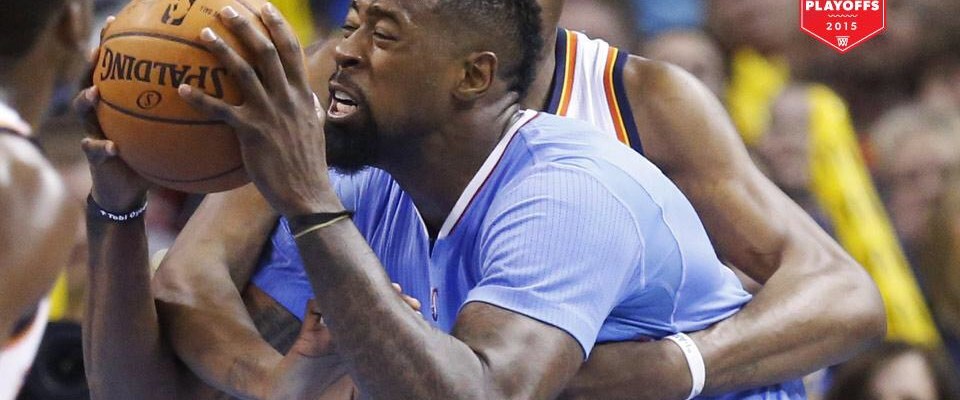
Each generation of NBA players has a predominantly terrible FT shooter on their team, who happens to be a big man who can dominate on any part of the court.
The 60’s had Wilt Chamberlain, career 51% FT 30.1 PPG 22.4 RPG.
The 90’s had Shaq, career 52% FT 23.7 PPG 10.9 RPG.
The new millennials have Andre Drummond (35% FT 17.3 PPG 15.2 RPG this season) DeAndre Jordan (42% FT 11.9 PPG 13.6 RPG 1.8 BPG) Hassan Whiteside (54% FT 12.3 PPG 11.2 RPG 3.9 BPG) and Dwight Howard (career 57% FT 18.0 PPG 12.7 RPG 2.1 BPG).
In basketball, or any sport, the common goal is to eliminate the opposing teams prime directive by neutralizing them through exploiting their weaknesses. So for these teams, when they are being dominated on the defensive or offensive end, they take to using the Hack-A-Player strategy to force their biggest weapon to use a skill at his lesser strength to hurt his own team while the other gains an advantage. If he misses the FT, the best rebounder is on the line and you have a greater chance of getting the rebound and another possession to bring your team back in the game. The fouls being used are by ancillary players on your team that you can waste them on without letting your primary weapons falter. It’s ingenious.
Despite how smart the strategy is, there are some basketball purist and fans of the game that believe it is poor basketball and makes the game slow. Well they are right by all means. But, it is within the rules and a great strategy to use while playing within the rules of the game.
However, there can be a solution or solutions to this new dilemma:
- MAKE YOUR DAMN FT’S!!!!! I know that there is a psychological part of the game that prevent people from making them, as well as a fundamental part (I went through it as the Hack-A-Player but it never worked because I showed up when need be. Plus, I never got to the line much despite playing more than most of the game). But practice and confidence helps. The more confidence you have, along with the right mechanics and routine the better chance you’ll make them. The less confidence you have, the less aggressive you will be. That even hurts your team more because you’re not on the floor for not making them or playing in a shell, and you can’t be on the floor for those reasons either.
- Treat it like HS/College/D-League. In these levels, if a player is fouled away from the ball, not within the last few minutes of a half or period, it is an intentional foul. The player who is fouled shoots the FT’s and his team recieves the ball on the n ext possession. The NBA already has the ‘Clear Path’ rule that gives the players ball back and this is essentially the same thing- an unnecessary foul that stops an impending scoring possession. It’s not that hard. He’s away from the play, why foul and be awarded for it?
These are just ideas on how to make the NBA game better for the players and fans because honestly, no body wants to watch or go through that shit in or outside of the game. It’s boring as hell.
My stance is not to say, award the poor FT shooter because you feel bad he can’t make his FT’s, and penalize the defense for taking the time to foul him and take advantage of him. It’s merely: award the team to get the ball back because the player was fouled away (not next to or going for a layup because that’s just basketball) from the ball and has no involvement with the play, at all, and penalize the fouling team for fouling away from the ball for an unnecessary intentional foul and give the offense the ball back. The only time to intentionally foul away from the ball would be to get them on the foul line. But by then, there should be offense defense subs so you wouldn’t have to worry about the poor FT shooter on the line, unless it was on a rebound. But hey, that’s the risk you run.
Call me crazy, but this should work. It does on all of the other levels, why not the NBA?
Photo courtesy of si.com
Stats courtesy of basketball-reference.com
 The Untamed Fan